I have been avoiding war-related movies. I find those American ones (say, Saving private Ryan, Pearl Harbor) are too heroic, too American-centric and too Hollywood-formulaic; While those Chinese ones (say Men Behind the Sun) are somewhat too close to home that watching is hurting.
Letters from Iwojima is the best movie I have watched in 2006, very solemn and heavy. It took me minutes of silence to recollect myself after watching it.
A sequel to the Flags of our Father, Letters is about the invasion of Iwojima from the Japanese point of view. The story follows that the Japanese soldiers, under the leadership of General Tadamichi had to plan for the best unsupported defense against the unparallel opponent’s force.
Through the flashbacks and letters communicated with their families, personal stories were told and smoothly interweaved with the battle scenes. These stories told the internal struggle, cultural influence, society pressure on these soldiers. These stories transcend nationality; the characters can be you and me. The character development and actors chosen for those roles are excellent. Ken Watanabe never disappoints.
Success of story: really hinges on the success of character development - characters that people can associate with and sympathize for. I thought of another recent movie, Curse of Golden Flowers. Apart from the distasteful and repetitive music, overly-colorful scene and over-exposed costumes, the weakest link is the unconvincing characters. Even I love Jay Chou as a singer, his role as the second prince (also a lead character) doesn’t convince me to have any sympathy, and same for all the rest of the troop.
Fighting Spirit: It reminded me how often I faced untouchable goals and was tempted to drop efforts. In 2007, I wish I can always fight with spirits, even when there is slim chance to win.
Showing posts with label Book Review. Show all posts
Showing posts with label Book Review. Show all posts
Monday, January 01, 2007

Friday, December 01, 2006
Neverwhere subway adventure


Just finished Neverwhere by Neil Gaiman, a fantasy thriller. The main character, Richard Mayhew, was punished by being a good Samarian. He saved a girl from the assassins, who killed her whole family. Strangely, Richard then ceased to exist in the world of London Above. To save his life, he had to join the girl to find out their destiny in the darkest and most dangerous par of the city, London Below.
If there is a story about the subway in Hong Kong, could it be a revolution of Robots who have been collecting profile of human through Octopus card?
Thursday, October 19, 2006
A Wall of Light
Israel, to me, is both a mysterious and intriguing place – so rich in culture, history, and religion yet all we have seen and heard from the media about this country are unfortunately and predominately violence and tragedies.
A Wall of Light, a finalist for the Giller Prize, is the third of the trilogy written by Eveet Ravel. It is the story of 3 emerging characters at 3 different periods – Anna, an actor who fled the oppressive Russia to start a new life in Israel during the 40s, embrace the new challenges and the freedom she finally had; Sonya, her daughter who had undergone two life-threatening events and had emerged into a deaf and detached University Professor; and Noah, Sonya’s nephew who was born in this country but had to leave for Berlin to escape the political and sexual identity struggle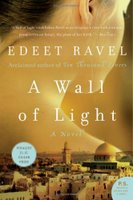
With the interweaving of Sonya’s adventure of “kissing a student, pursuing a lover, finder her father and leaving her brother”, Anna’s letters to her lover who was left behind in Russia, and Noah’s diary entries during his childhood and teenage, Ravel presented us a contemporary insider view of the country which is “capable of producing intelligent babies but manages to turn them into morons, gradually, bit by bit, until at fifty they are nearly brain-dead”, and yet with personal and emotion touch.
A Wall of Light is not too heavy or gloomy as you will imagine book about the Arab-Israeli politics. The language is beautifully done and crafted a very vivid scenery and characters. I checked the author’s site and was surprised to find the author rewrite one of her earlier book “Look for me” and actually post the new ending of the book on her website. It showed some seriousness and search for quality about her own right. I might read more of her books in the future.
A Wall of Light, a finalist for the Giller Prize, is the third of the trilogy written by Eveet Ravel. It is the story of 3 emerging characters at 3 different periods – Anna, an actor who fled the oppressive Russia to start a new life in Israel during the 40s, embrace the new challenges and the freedom she finally had; Sonya, her daughter who had undergone two life-threatening events and had emerged into a deaf and detached University Professor; and Noah, Sonya’s nephew who was born in this country but had to leave for Berlin to escape the political and sexual identity struggle
With the interweaving of Sonya’s adventure of “kissing a student, pursuing a lover, finder her father and leaving her brother”, Anna’s letters to her lover who was left behind in Russia, and Noah’s diary entries during his childhood and teenage, Ravel presented us a contemporary insider view of the country which is “capable of producing intelligent babies but manages to turn them into morons, gradually, bit by bit, until at fifty they are nearly brain-dead”, and yet with personal and emotion touch.
A Wall of Light is not too heavy or gloomy as you will imagine book about the Arab-Israeli politics. The language is beautifully done and crafted a very vivid scenery and characters. I checked the author’s site and was surprised to find the author rewrite one of her earlier book “Look for me” and actually post the new ending of the book on her website. It showed some seriousness and search for quality about her own right. I might read more of her books in the future.
Wednesday, October 11, 2006
Stephen King - On Writing
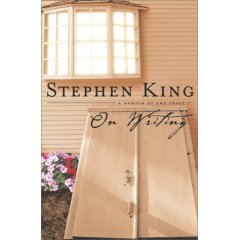
I have asked around for recommendations of good writing books and many suggested On Writing as one of the best. King himself noted on the Foreword that “most books about writing are filled with bullshit” and he would try to keep his short. In fewer than 300 pages, King just did that, and did it beautifully. Earnestly, directly, and precisely, King delineated his path to a writer and his childhood in Part I - C.V.; presented us the key skills for good writing, with lots of examples, good and bad in Part II, Toolbox; and illustrated what made a good writer to better writer by addressing common writing topics such as writing genre, techniques of narration, description, dialogue, plot, character development and theme…etc.
It is a quick yet insightful read. King really had done what he preached – omit needless words. There are a couple of other “commandments” or thoughts which I find tremendously useful or refreshing: -
· If you don’t have the time to read, you don’t have the time or the tools to write.
· The road to hell is paved with adverbs, and I will shout if from the rooftops.
· Stories are found things, like fossils in the ground. Stories are relics, part of an undiscovered pre-existing world.
· Description begins in the writer’s imagination, but should finish in the reader’s.
· Starting with the questions and thematic concerns is a recipe for bad fiction. Good fiction always begins with story and progresses toe theme
· Writing fiction is like crossing the Atlantic Ocean in a bathtub (plenty of opportunity for self-doubt.) (So, King’s advice is to take story through at least two drafts – one with the study door closed and the one you do with it open)
· Life isn’t a support-system for art. It’s the other way around.
Thursday, October 05, 2006
The Man Who Mistook His Wife for a Hat
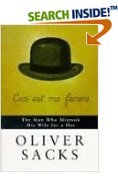
I bought this book under my dad's recommendation 10 years ago. It traveled with me around the world from Hong Kong to Beijing, San Francisco, Seattle and now Toronto. Maybe the cover never appeals to me, I never read through the first 5 pages until today.
This is a book with strange tales, in fact real human stories of patients who suffer different kinds of neurological problems, such as a man who saw his wife as a hat, a disembodied lady who cannot feel her body unless staring the parts with her eyes, another woman who can only see or perceive the right side of things. These are patients who have perfect visual sense, yet different kinds of neurological syndrome that altered perceptions. Neurologist, Oliver Sacks has done a fascinating work in depicting the cases at a highly scholarlistic way with much medical details and references. At the same time, Sacks has been able to explain complicated concept in layman terms and with compassion. His stories touched the general reader with his genuine appreciation in human being, connecting science, real life and his own personal feeling. Whether you have serious interests in brain and mind, this book is both informational and entertaining.
Subscribe to:
Posts (Atom)